Industry
What is it?
Industry 4.0 is the most recent notion of industry, integrating the main technological innovations in the areas of automation, control and information in manufacturing.
The trend in production processes is for them to become increasingly independent, efficient and adaptable, through Cyber-Physical Systems, the Internet of Things and the Internet of Services.
This means a new era in the context of industrial revolutions. The way products are manufactured will change, thus affecting different areas of the market.

The main principle of Industry 4.0 is that by interconnecting machines and systems, companies can create intelligent networks that control production parameters independently.
For example, scheduling maintenance, predicting failures or adapting to unplanned changes in production.
Principles
Intelligent production systems that tend to emerge in the future through Industry 4.0 are defined by these 6 principles:
- Real-time operation: The ability to operate in real time translates into the acquisition and processing of data almost immediately, enabling real-time decision-making.
- Virtualization: Simulations are already used today, as are supervisory systems. However, Industry 4.0 proposes the existence of a virtual copy of smart factories, allowing remote monitoring of all their processes through sensors spread across the plant.
- Decentralization: The system can make decisions according to real-time production needs, receive commands and provide information about its work cycle.
- Service orientation: Use of service-oriented software architectures combined with the Internet of Services concept.
- Modularity: Production according to demand, coupling and decoupling of modules in production, offering flexibility to change machine tasks.
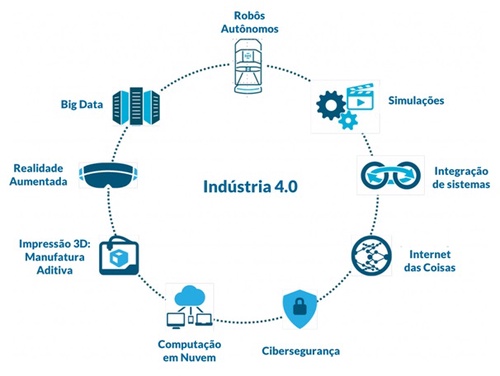
What it is based on
Based on the principles above, Industry 4.0 is a reality made possible by the technological advances of the last decade, combined with technologies under development in the fields of information technology and engineering.
These are some of the most relevant technologies:
- Internet of Things: Consists of networking physical objects, environments, vehicles and machines through implemented electronic devices that allow data collection and exchange. Systems based on the Internet of Things are called cyber-physical and have sensors and actuators.
- Big Data Analytics: Very large and complex data structures that use new approaches for capturing, analyzing and managing information. Applied to Industry 4.0, Big Data technology consists of 6 C’s to handle relevant information: Connection, to the industrial network, sensors and PLCs; Cloud (cloud/on-demand data); Cyber (model and memory); Content; Community (share information); Customization (personalization and values).
- Security: The security and robustness of information systems is the great challenge for the success of Industry 4.0. Transmission failures in communication between machines or a simple system bug can disrupt production.
Impacts
Industry 4.0 will undoubtedly affect the entire market, creating new business models.
In an increasingly demanding market, most companies seek to integrate individual customer needs and preferences into the product, avoiding prior customization of the product by consumers, thus facilitating the manufacturing process.
Research and development in the areas of information technology security, production reliability and machine interaction will be another aspect affected by Industry 4.0. This is because technology must develop continuously in order to make it possible for companies to adapt to this new industry standard.
Professionals will also be affected, since the replacement of manual work by automated labor is growing. In addition, they will need to adjust, because with more automated factories, new demands will arise and others will cease to exist.
On the other hand, demand in research and development will offer opportunities for technically skilled professionals with multidisciplinary training to understand and work with the variety of technologies that make up a smart factory.
i4.0 Program
The Industry 4.0 Program is an initiative of the Portuguese Government that aims to accelerate the implementation of Industry 4.0 in Portugal.
This program has 3 main objectives:
1. Accelerate the adoption of i4.0 by the Portuguese business fabric
Provide the business sector with knowledge and information
Promote a set of tools for business transformation
Train and readjust the national workforce
2. Promote Portuguese technology suppliers as i4.0 players
Capitalize on the scientific and technological ecosystem
Create a favorable context for the development of i4.0 startups
Promote national technological solutions in an international context
3. Make Portugal an attractive hub for investment in i4.0
Create favorable conditions (legal and tax) for investment targeted at Industry 4.0
Netuno in Industry
With the maturity of the Netuno Platform constantly evolving over its 18 years, the development of all BackEnd service layers is optimized and robust, which saves time and programming, resulting in fewer hours/project, bringing confidence in meeting the schedule and the assurance that the intended restructuring will achieve the highest performance levels in production.
Due to its high performance, multi-user nature, robustness and security, Netuno wins over large companies and experienced developers every day.
The user experience in an application of this type is fully immersive, which reduces user fatigue when dealing with the app's resources and increases their level of concentration.
- Greater fluidity - Use of SPAs for each different area – Using React + Redux enables targeted updates of components, without ever needing to refresh the entire page. This makes navigation much more fluid and faster for the user.
- Better use of resources - FrontEnd server separate from the BackEnd server – Redux handles all processing/handling of data that is rendered, implementing cache state control mechanisms. With this approach, the BackEnd server has less load, allowing greater processing capacity.
- Greater interoperability - BackEnd agnostic to FrontEnd – Considering a SoC architecture, where the BackEnd provides its functionalities via RestAPI, the system is expandable so that in the future other applications can communicate with this BackEnd.
- Greater scalability - Based on Netuno's web-based backoffice, it is possible to add data structures without code changes.
- Speed of development and maintenance - Netuno implements low-code logic that enables rapid development and maintenance of the application's base services.
- Greater web-based control - Through the application backoffice, it is possible to directly access a simplified IDE that supports features such as Coding and Queries, etc.
From Raw Material to Production
With the benefits Netuno offers, it is applicable to solving problems in all industrialization sectors.
In the collection of information and management of data and processes from the origin of the raw material to the production of the final product.

Netuno drives production by ensuring less waste and reducing failures.
From Distribution to Sale
Where business begins and where business ends is not a limit for Netuno.
Assist in orchestrating the relationship with other critical stakeholders to ensure the entire business flows as desired.

Netuno guarantees improvement throughout the entire process, from origin to the final consumer.
Lean Six Sigma Methodology
The Lean Six Sigma methodology is widely applied in industry but also in various types of business.
Aiming to achieve the best possible optimization to avoid waste and reduce failures, increasing overall quality.
This methodology is divided into 5 phases, known as D.M.A.I.C.:
- Define (Define):
- Establish who will carry out the project;
- Define problems objectively;
- Focus on the most relevant and viable needs;
- Think about the improvements that can be implemented;
- Measure (Measure):
- Evaluate process performance and analyze the numbers;
- Obtain detailed data and information about the process;
- Find possible causes of problems;
- Analyze (Analyze):
- Think about the root causes of problems that affect the process and management;
- Analyze the best options to correct these causes;
- Create improvement opportunities;
- Improve (Improve):
- First test possible actions by observing the pros and cons;
- Execute the action plan according to the needs;
- Implement the change;
- Control (Control):
- Monitor changes to the established process;
- Establish control criteria such as task lists and statistics;
- Analyze the overall performance achieved;
- Seek continuous process improvement;

A perfect fit between the Lean Six Sigma methodology and Netuno.
Netuno supports automation to improve the 5 phases defined in the methodology:
- Define: With the information that can be obtained, centralized and analyzed, it enables a better definition of the improvements to be applied with greater precision.
- Measure: Through the ability to create integrations to collect large volumes of data manually and automatically.
- Analyze: Generate reports, dashboards and export data to other analysis tools.
- Improve: Finding what can be improved involves a human decision that can be supported by automatic mechanisms based on information.
- Control: In management, alarm processes and real-time information visualization.
Across the board, Netuno is the platform that supports the entire process of optimization and continuous improvement in industry and business in general.
For the Entire Industry
Netuno is not limited to a specific industry sector; rather, it is comprehensive for any type of industry as well as any type of business.
There are countless ways in which Netuno is already applied in industry and business and it can be applied in many other ways.
As a platform that assists and guarantees quality gains from development through execution.
Netuno is applicable both in industry and in any other type of business, with no defined limitations, only limitations yet to be explored.